

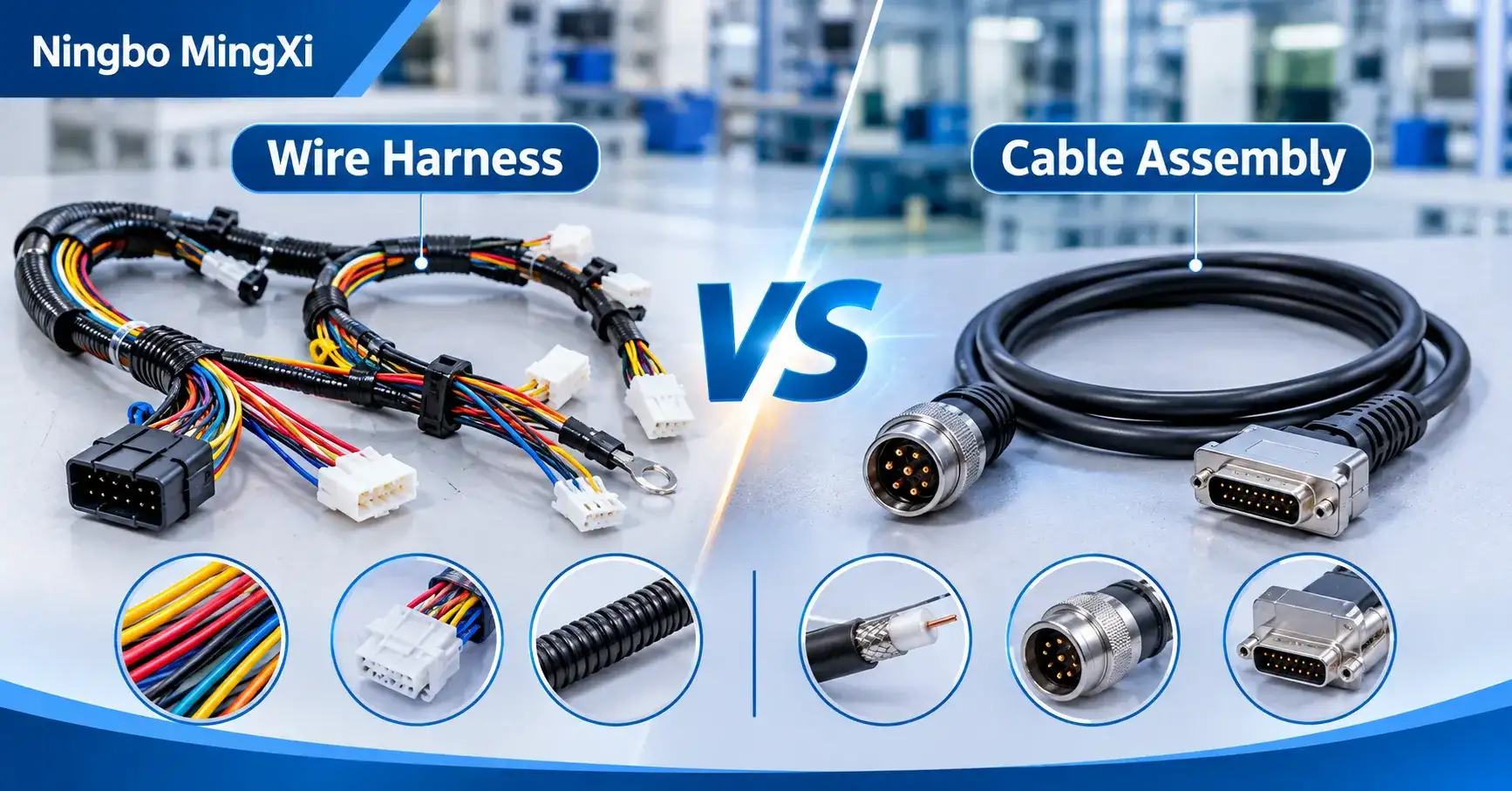
Treating a wire harness and a cable assembly as the same product may seem like a minor terminology mistake. But that assumption can affect the design, installation process, testing requirements, and many other factors when you are manufacturing a product. A wire harness will be more compatible when you need to organize and route multiple circuits through a complex product. A cable assembly will prove to be the better option when signal integrity, shielding, high voltage, or a defined point-to-point connection matters most. That is why the correct choice depends less on the number of wires and more on the assembly’s electrical and installation requirements. Industry terminology also varies, so you should evaluate the actual construction and application. This guide explains the key differences between a wire harness and a cable assembly, where each is typically used, and how to specify the right OEM wiring solution.
A wire harness is a grouped arrangement of individual wires or cables organized into a defined routing structure. It combines multiple circuits into one manageable assembly that can be installed inside a machine, vehicle, appliance, or other finished product. New to the topic? Our beginner guide explains what a wire harness is in plain terms.
A wire harness usually includes:
The layout of wires varies from product to product. Most are usually cut, stripped, tested, and bundled to match the space and configuration of the product. The harness is spread out to match the physical shape of the equipment, including bends, mounting locations, and connection points.
This means an engineer can install several related circuits as one organized unit, which is the wire harness. This simplifies the process of assembling the circuit. Instead of routing and connecting each wire separately, the wire harness is just fitted into the product with one small procedure. For production teams, this can reduce installation time and make the product easier to service.
Wire harnesses are common in applications where several components must connect across different physical locations. Gadgets and machines that have a wire harness in them include:
A harness connects different electrical or electronic components through its wires, like switches, sensors, motors, displays, power supplies, and actuators within the same product. So, its design is often closely tied to the product’s shape and dimensions. For example, an industrial wiring harness for automation control systems ties sensors, relays, and drives together inside one cabinet.
A cable assembly is one or more cables consisting of connectors, contacts, terminals, or other end components. Unlike a harness made primarily from a bundle of separate wires, a cable assembly often begins with a manufactured cable that already contains a defined conductor, insulation, shielding, or jacket structure.
Cable assemblies use specialized cables such as,
The cable itself is a special cable that is selected for a particular electrical or mechanical performance requirement. For example, a high-speed data cable may need controlled impedance and shielding, while a high-voltage cable may require specific insulation thickness and creepage protection.
That is why cable assembly manufacturing often involves more than cutting and terminating conductors. The cable assembly should be durable as well as fulfill performance specs. For engineers and procurement teams, the cable assembly supplier should deliver build quality with shield preparation, backshell installation, connector torque, bend radius, polarity, and optical performance.
Cable assemblies are a major component in,
They are especially useful when the cable’s construction is crucial for system performance. A cable assembly can provide a defined point-to-point connection that is easy to install, remove, replace, or test.
So, if your application or product depends on low-noise transmission, high-speed data, or high-voltage insulation, a cable assembly can be a fundamental aspect of operational performance.
The terms overlap, but the underlying design priorities are often different. The following comparison can help you evaluate the distinction from an OEM perspective.
|
Consideration |
Wire Harness |
Cable Assembly |
|
Basic construction |
Usually uses multiple discrete wires grouped into a route |
Usually uses one or more manufactured cables with defined construction |
|
Typical layout |
Often branched and shaped to match product geometry |
Often point-to-point, although complex cable assemblies can also branch |
|
Primary design focus |
Routing, circuit organization, installation efficiency, and integration |
Electrical performance, interface control, environmental protection, or modularity |
|
Electrical priorities |
Circuit separation, connector compatibility, voltage and current handling |
Impedance, shielding, attenuation, crosstalk, data rate, or specialized power performance |
|
Mechanical features |
Clips, ties, clamps, grommets, labels, and breakouts |
Strain relief, backshells, overmolding, bend control, and connector protection |
|
Common applications |
Vehicles, machinery, appliances, control systems, and automation equipment |
Communications, sensors, test equipment, medical systems, aerospace, and power systems |
|
Installation method |
Often installed as an integrated route within a larger product |
Often installed as a removable or defined point-to-point connection |
A wire harness commonly uses separate insulated wires that are bundled into a defined route. The assembly will split into multiple branches, with each branch leading to a different component.
A cable assembly generally starts with a cable that has already been manufactured with its conductors, insulation, shielding, and jacket. The cable contains multiple conductors, but those conductors are usually held within a common cable structure. There are no individual components connected to the cable.
That difference matters during design and production. If your machine or electronic equipment contains many components spread across a complex physical layout, a wire harness will reduce installation work, and assembling the product will be quick and hassle-free. But if the connection must maintain a specific electrical characteristic from one interface to another, a special cable assembly may offer better control.
Cable assemblies require tighter control over several performance indicators.
For example, a communications link can fail even when every conductor is correctly terminated. The problem may come from excessive signal loss or poor shielding termination. It can occur due to an incorrect bend radius.
Wire harnesses can be made of lower-quality insulation or shielding because their purpose is different. Here the focus is on circuit separation, connector compatibility, and reliable power distribution. But that does not mean harnesses lack electrical requirements. A harness carrying motor power, or sensitive sensor signals still needs appropriate conductor sizing, insulation, separation, and testing.
Both products need to be durable enough to withstand vibration, abrasion, moisture, electromagnetic interference, and other environmental factors.
To select the right harness or cable assembly, an engineer or procurement team should be deeply aware of the environment in which it would function. Include temperature ranges, vibration levels, flex cycles, fluid contact, washdown conditions, and expected service life. That gives your supplier information they can use to select the right materials and construction.
A wire harness may be appropriate when your assembly consists of
For example, a machine with sensors, valves, switches, and control modules may benefit from a harness designed around its frame and access points.
A cable assembly proves to be the better choice when your design requires the following,
For instance, a shielded cable assembly may connect a sensitive sensor to a controller without exposing the signal path to unnecessary electromagnetic interference. A high-voltage battery cable assembly may use specialized insulation, terminals, seals, and protective routing to support safety and service requirements.
Many custom products use both solutions in their construction. A wire harness may route low-voltage control circuits throughout a machine. It will separate shielded cable assemblies that connect sensors, motors, battery modules, or communication interfaces. This hybrid architecture improves serviceability, signal performance, and manufacturing efficiency. So, you do not need to force every connection into one category. Select the assembly type that fits each circuit’s function and operating environment. A good example is an electrical control panel. The internal wiring runs as a harness, while the sensor lines use shielded cable.
Before selecting a cable assembly or wire harness supplier, make sure to ask the following questions,
These questions reveal whether the supplier understands your application and has the production discipline required for repeatable quality. Buying in volume? Ask about wholesale wire harness pricing and tooling costs before you commit.
A wire harness is generally optimized for organized routing and the integration of multiple circuits. A cable assembly is generally optimized around a cable’s electrical, mechanical, or interface performance. But the boundary is not universal. Product names vary between suppliers and industries, so the label alone should never serve as your specification. Instead, define the construction, performance, environment, installation method, testing, compliance requirements, and service expectations. Then evaluate whether a wire harness, cable assembly, or hybrid design best supports the product. That is why choosing the correct assembly begins with understanding the product’s function.
Got a wire harness or cable assembly project coming up? Send your drawing or spec sheet to Ningbo MingXi, and the team will review it and come back with a quote.
A custom wire harness is tailored to your exact application. It delivers optimal fit, reduced installation time, and improved product performance compared to standard wiring solutions.
You’ll need specifications such as wire type, connector requirements, and circuit layout for product compatibility. For the quality of the harness itself, you need to consider environmental conditions (heat, moisture, vibration) and any compliance standards (UL, ISO, etc.).
They ensure compatibility with unique equipment, reduce installation errors, improve durability, and meet specific industry standards (UL, ISO, RoHS).
Provide details such as cable type, connector style, operating environment, voltage/current requirements, and compliance needs. The manufacturer will design and prototype accordingly. You can send your specs through the contact page.
Power cable assemblies are engineered to safely transmit electricity at specific voltages and currents, often with reinforced insulation and connectors to handle heavy loads.
Treating a wire harness and a cable assembly as the same product may seem like a minor terminolog
READ FULLBuilding services, HVAC, security, lighting, transportation, production facilities, treatment and
READ FULLElectronics, especially machines, are incomplete without PCBS, microcomponents, and wire harnesse
READ FULL

Have a question or need a quote? Fill out this form and our team will get back to you quickly!