

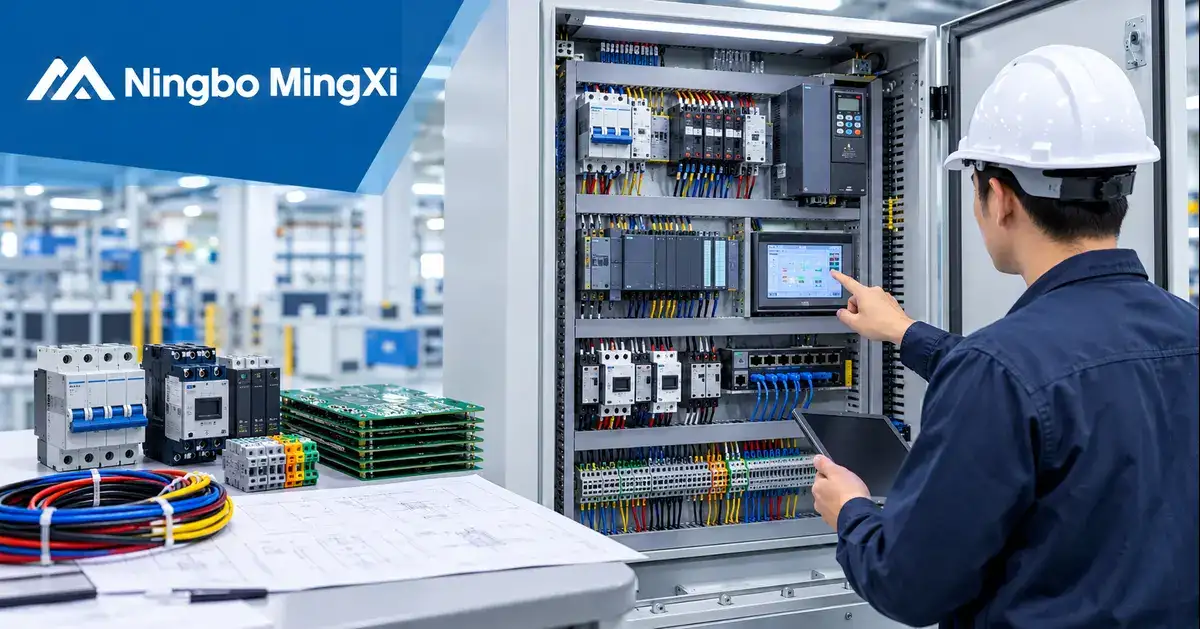
Building services, HVAC, security, lighting, transportation, production facilities, treatment and energy plants, the healthcare sector, retail stores, offices, and malls need a stable power supply. They need something that can deal with power surge risks, manage the power, and even automate the operations. That is none other than an electrical control panel. What is an electrical control panel? It is something that deals with power challenges before any appliance gets its desired power. You will get your answers in this blog once you start reading it.
It is an enclosed system of electrical and electronic components that manages all the electricity-related operations alone. It controls, distributes, and monitors power supply at low and medium voltage levels. Not only that, but it also protects all these components and appliances connected to the panel from accidents. All the components and devices inside an ECP are connected through DIN rails, wires, and terminal blocks. This whole ECP has a metallic, fiberglass, or plastic enclosure depending on different conditions. Industrial buyers usually order these as custom electrical control panels built around their load and layout.
There is quite a wide number of components and devices inside an electrical control panel. Each component performs a key job to coordinate primary functions in managing the power. Some components manage power supply, and some perform protective tasks to prevent damage. The following are all the components you will find in an ECP with their core functions.
The first is a circuit breaker that is in the top section of the enclosure. It protects and isolates the panel for power supply and maintenance operations, respectively. Usually, it operates between voltage levels like 120V and 480V depending on the safety limits of appliances.
Then we have fuses and surge arrestors that manage the protection of ECPs. They are in the distribution section inside the panel. Surge arrestors divert the current spikes to the ground safely. With the help of sensors, they detect the surge and instantly manage it to protect sensitive components like PLCs from high-voltage damage.
Fuses provide one-time protection by instantly breaking the connection if they detect excessive voltage. All they have to do is melt down to cut off the connection when the voltage exceeds the limit.
They step down high voltage to an allowed limit into a safe range for appliances. For instance, they convert 400 V into a safe range of 220V, 110V, 24V, and so on. Another function of transformers inside ECP is to isolate the power supply for safety during the maintenance process. Their core function is to provide protection to sensitive components and appliances that require a specific power range to operate.
It is a Human-Machine Interface, which provides access to operate an electrical control panel. It allows a user to adjust settings, alarms, and track the performance of the ECP. It has a screen that provides all essential information like voltage, current, temperature, and personalized settings. Commercial, industrial, and residential installations get better assistance from it in setting adjustments as per power limits.
Contractors are switches that perform heavy operations like turning on and off appliances like motors. To prevent any damage to motors inside appliances, overload relays monitor and control power flow. They ensure motors can not hold current long enough to cause burnout. These two components safely manage operations where powerful appliances require careful load management in starting and shutting operations.
A PLC (Programmable Logic Controller) connects the HMI with the rest of the components in ECP. PLC is the central brain that manages every logical operation to smartly run any ECP. Without it, it is impossible for components to function with high coordination. A PLC helps in monitoring, automating, tracking, and managing the entire ECP. It precisely transforms data from input to output.
They are tiny plastic blocks that connect internal components of the ECP by maintaining the flow of current. Wires and terminal blocks help in power distribution throughout the ECP. Organizing connections through labeled wires is not possible without terminal blocks. They ensure there is smooth signal routing without any risk of current clash or failure. A PLC controls all the signals through these terminal blocks and wires. In bigger panels, wiring is often supplied as a ready-made wire harness to keep connections neat.
Then we have a network switch, which interlinks internal digital devices like HMI, VFD, PLC, and sensors. It routes data among digital devices where it belongs. Its core function is to provide two-way communication among all these core devices in an ECP. Network switches have multiple types, such as managed, unmanaged, layer 3, and PoE switches. They have different compatibility with systems and appliances depending on the user’s requirements.
A safety controller operates all the safety components and devices in an ECP. It ensures all of them work instantly as soon as there is a power surge. What it does is detect faults and manages the emergency stop buttons. It also commands contractors and overload relays in the power reduction process.
They manage the core operations of operating heavy motors in every appliance. Motor starters turn on, off, and protect motors from overheating through their built-in overheat and overcurrent protectors. They are like a combination of a contractor and an overload relay. They ensure heavy-duty motors in industrial appliances get a smooth start and shutdown without any risk of failure. For motor, pump, and valve setups, the control board can also be built as an industrial control PCBA for motor and pump systems.
A VFD manages the speed of an AC electric motor to prevent full-speed operations that could cause damage. What it does is convert AC power into DC power. It also provides a soft start to save energy and protect appliances from damage. A VFD prevents excess energy storage in motors, so there is no risk of overheating and burnout.
There are some guidelines that you need to follow for safe operation. There are lots of risks involved that need special attention. The following are the guidelines that will help buyers and users comply with safety rules.
An electrical control panel is a device that contains all the components to manage the power and protect appliances/components from surges. They provide uniform electric flow with monitoring and automation of power control in residential, commercial, and industrial applications. These component-loaded smart enclosures require regular maintenance to prevent faulty components and reduce the risk of accidents. Every sector looks for safe and globally compliant ECPs for reliable performance.
Depends on your country. In the US, look for UL 508A on industrial control panels. The wiring itself follows NFPA 70, the National Electrical Code. Elsewhere, IEC 61439 is the one you'll see most. But ask for proof, like a UL label or a test report. "Yes, it's compliant" isn't proof. And a panel that fails inspection? That can cost you weeks.
Once a year at the very least. Plants that never shut down usually check twice. Open it up and just look. Loose terminals, wires that look browned, dust piled up inside, anything worn. But power it down and lock it out first. Always. A live panel can hurt you badly, even if you're only looking.
Go to the factory if you can. Resellers add their cut, and half the time they can't answer a technical question anyway. Ningbo MingXi is a Chinese manufacturer that builds electrical control panels, and its website is a good place to see what it offers. Already have a layout in mind? Send it over and ask for a price.
Yes. Most panels end up custom anyway, because no two plants look the same. Tell the manufacturer how much power you need and how much space you've got.
Think about the load before anything else. What's the panel going to run? Motors, mostly, plus lights and whatever gets added later. Add it all up, then add a bit more, because plants grow. After that, look at where the panel will sit. A dusty floor or a hot, damp corner needs a tougher enclosure than a clean office. Good protection parts matter too, and so does a PLC if you plan to automate.
Building services, HVAC, security, lighting, transportation, production facilities, treatment and
READ FULLElectronics, especially machines, are incomplete without PCBS, microcomponents, and wire harnesse
READ FULLNo electronic gadget or device is functional without a PCB assembly. It is the most important pro
READ FULL

Have a question or need a quote? Fill out this form and our team will get back to you quickly!