

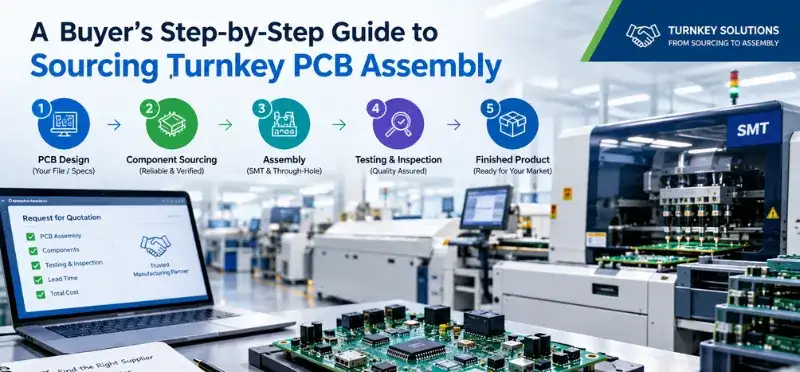
When purchasing PCB assemblies, the best approach is to treat the initial RFQ as an engineering review rather than merely a price quote. The actual threats include poor quality, unexpected expenses, missing files, component alterations, and production delays.
A good supplier will reveal those risks prior to the production phase. This guide details how to prepare files, compare quotes, move through DFM, prototype, inspection, and delivery. Use it as a checklist when comparing PCB assembly services from Chinese suppliers.
The fundamental process is straightforward and involves creating the data package, receiving itemized quotes, conducting DFM/NPI, obtaining first-build approval, releasing production, inspecting lots, and shipping on agreed-upon commercial terms.
Turnkey assembly is where the manufacturer purchases the PCB and agreed components, assembles and tests the parts, and then ships the completed PCBA. Your primary responsibility is to deliver the technical package and to approve substitutions/exceptions.
Consigned assembly means that you send the parts and the factory assembles them. You are more responsible for purchasing, shortages, packaging, and, at times, traceability.
Partial turnkey is in between the two. It is possible to provide high-cost ICs or custom parts and have the factory purchase the PCB, passives, and any other agreed components. Explicitly state the model in the RFQ.
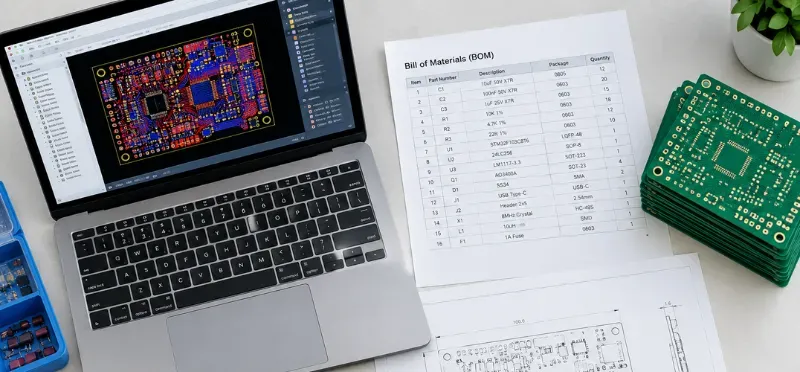
A good RFQ package normally includes:
Some typical issues include the BOM revision not matching the Gerbers, missing MPNs for connectors, incorrect polarity, and the pick-and-place origin not matching the board.
Revise prior to RFQ and freeze the revision. Request that the supplier provide the same package and itemize all assumptions. The hardware engineer should also verify that the board revision number, the BOM revision number, and the assembly drawing all refer to the same production release.
A usable quote should separate the major cost drivers:
|
Quote item |
What to check |
|
PCB fabrication |
Layers, material, thickness, finish, quantity |
|
Components |
BOM total, sourcing method, alternates, shortages |
|
SMT/THT assembly |
Assembly charges and side/process coverage |
|
Tooling |
Stencils, fixtures, test jigs, programming |
|
Testing |
AOI, X-ray, functional or other agreed tests |
|
Engineering/NPI |
DFM, first-article, setup charges |
|
Packaging/shipping |
ESD packing, freight, Incoterm, destination responsibility |
The red flag is a price that isn't necessarily high; it's one that's not specified. The term "PCBA: $X" does not indicate if it includes sourcing, tooling, testing, and freight.
Inquire about what to do when a BOM part is unavailable. The supplier should indicate if there are approved alternatives, who approves them, and if there are any shortages, how they will impact the schedule.
This is also the place where you can verify the validity of a quote for a procurement manager. The pricing of semiconductors, connectors, and power components may shift from RFQ to purchase order. Semiconductor, connector, and power-component pricing might jump from RFQ to purchase order.
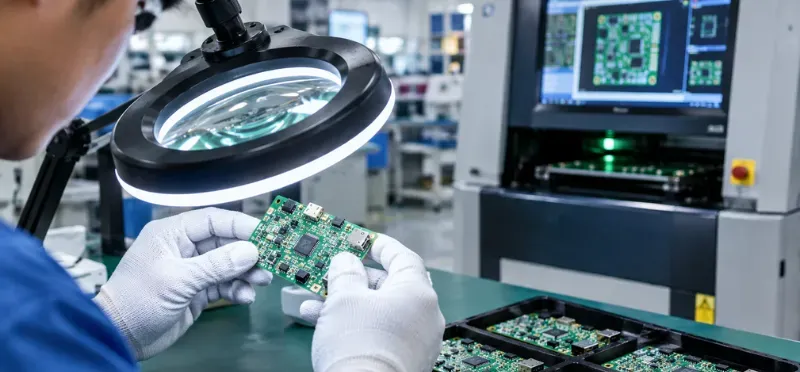
One of the quickest ways to introduce the same defect across an entire batch is to skip DFM.
In China, for SMT assembly production, check spacing, pad/land patterns, solder mask clearances, paste apertures, polarity, package availability, and orientation. For THT, consider hole size, lead length, insertion direction, and solder access.
The NPI engineer should log them to a board revision and then resolve them before releasing the board. A helpful discovery is specific: R17 is 0.35 mm from the neighboring pad; confirm or change. One-line "DFM passed" is not sufficient.
Never approve a prototype solely because it turns on. Verify the dimensions, connectors, labeling, firmware/programming, and functional test criteria prior to volume production.
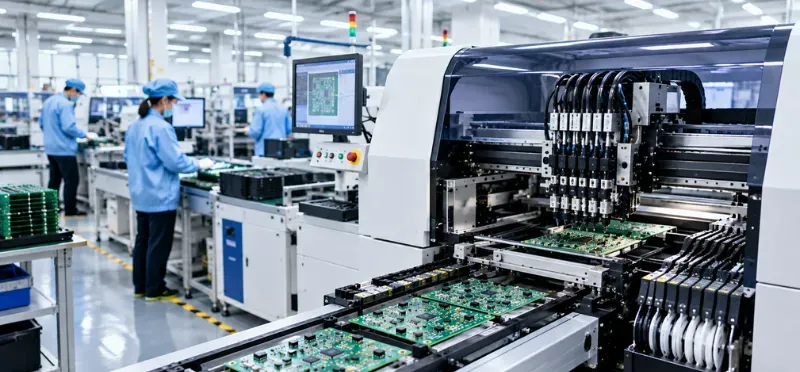
The same BOM and Gerber revision should be used for production as for the pilot build.
Commonly used processes include solder paste printing, pick-and-place, reflow, THT/DIP (if applicable), AOI inspection, visual inspection, and functional testing. X-ray inspection is particularly helpful for bottom-terminated packages and BGAs.
AOI does not test a circuit; it tests workmanship. Establish functional test limits, programming responsibility, and fixture ownership prior to production.
Never compare prices at the factory without comparing delivery terms.
FOB makes the supplier responsible for the duties and costs on the export side up to the named port, and the buyer responsible for the principal duties and costs on the import side. Under DDP, the supplier arranges for the goods to be delivered to the agreed destination and assumes responsibility for, and handles, import clearance, subject to the contract and destination rules.
Clarify Incoterms, place, shipping, and whether freight is included.
The travel time depends on the destination and how the trip is made. Separate manufacturing lead time from freight transit time.
It's okay for a company to be a trading company, but the purchaser needs to know who's doing the actual production.
Prior to selecting a PCB assembly manufacturer, request the legal company name, manufacturing address, evidence of a current (working) factory, equipment list, sample inspection records, and the engineering contact who will oversee your build. Who does SMT, THT, testing, and procures components?
The supplier also has to be transparent about the location of your BOM, who has the authority to approve substitutions, and who keeps the production records. It's important whether you're working with an electronics manufacturing services (EMS) provider, contract manufacturing partner, or direct factory.
At Ningbo MingXi, we have SMT assembly, DIP assembly, component sourcing, factory testing, box-building production, and other manufacturing processes all in our factory in Ningbo, Zhejiang Province.
Before the first PO, confirm:
Use a controlled Gerber set, BOM, pick-and-place file, assembly drawing, and test requirements. After that, request itemized quotes, understand the terms and lead times for the components, perform DFM/NPI, approve the prototype, and confirm inspection and shipping terms before entering volume production.
Turnkey PCB assembly is a PCB manufacturing model in which the supplier sources the PCB and agreed-upon components, assembles the PCB using SMT/THT, tests the PCB, performs other defined manufacturing processes, and finally delivers the PCB to the customer. Buyer provides the technical package and accepts substitutions, exceptions, and final commercial terms.
Submit Gerber files, an up-to-date BOM (manufacturer's part numbers), a pick & place file, assembly drawings, and fabrication and test notes. When applicable, add revision numbers, special inspection requirements, approved alternates, and programming files. The objective is to provide the supplier with one package per quotation and one per review.
Depending on the board's complexity, the availability and quantity of components, the NPI work, and the shipping method. Request separate manufacturing and shipping dates.
It can be successfully managed by vetting the supplier, managing the engineering package, obtaining written approval for substitutions, specifying inspection procedures, and establishing clear commercial terms. The scenarios and real-world concerns are: Are there processes, records, and responsibilities that are clear and contractually agreed by the supplier?
The safest approach to acquiring turnkey assembly is to create a set of measurable checkpoints passed from one value chain stakeholder to the next: controlled files, itemized costs, documented DFM activity, an approved prototype, defined inspection criteria, and explicit shipping terms. Once it is ready, you can request a quote from turnkey PCB assembly China services. Maintain the first RFQ practice: request that the supplier provide assumptions/exceptions with the price.
Building services, HVAC, security, lighting, transportation, production facilities, treatment and
READ FULLElectronics, especially machines, are incomplete without PCBS, microcomponents, and wire harnesse
READ FULLNo electronic gadget or device is functional without a PCB assembly. It is the most important pro
READ FULL

Have a question or need a quote? Fill out this form and our team will get back to you quickly!